

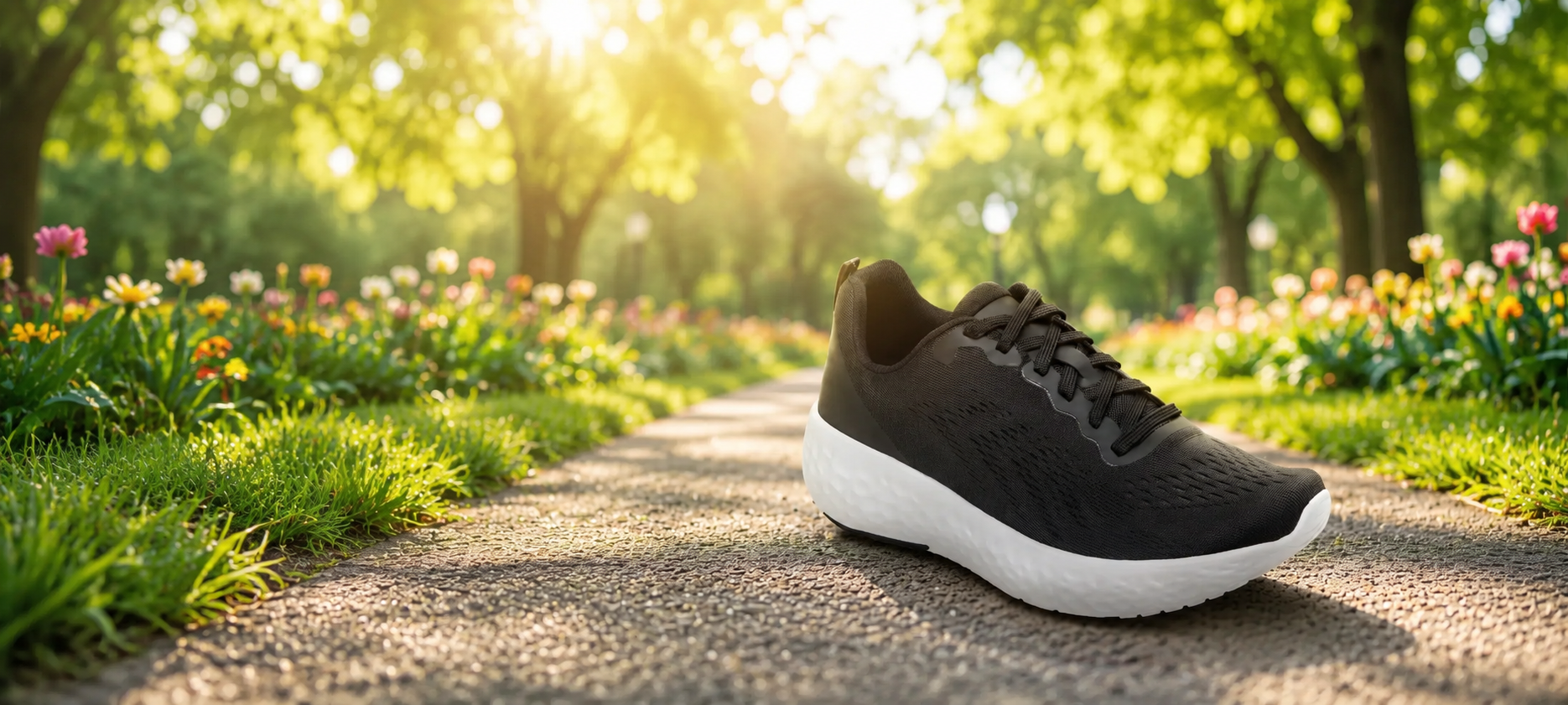
If you've ever gotten out of bed and felt that first stabbing pain in your heel, you already know plantar fasciitis doesn't care about your schedule. It's one of the most common causes of heel pain, and the single biggest lever you control every day is what you put on your feet. The right shoe won't cure plantar fasciitis, but an unsupportive one can make symptoms worse.
This guide breaks down what actually matters when shopping for plantar fasciitis, and where to find it — sneakers, sandals, slip-ons, and boots — with honest tradeoffs, not just a sales pitch.
Plantar fasciitis is inflammation of the plantar fascia, the band of tissue running from your heel to the base of your toes. It's commonly associated with flat feet and overpronation, where the arch collapses inward under weight. That's why arch support matters so much here: it's the feature that helps a shoe hold the foot's shape through the step. This is general information, not medical advice — see the note at the end.
A properly engineered arch support does two things: it limits how far the arch collapses under load, and it redistributes pressure away from the heel and across the whole foot. That's the mechanism — mechanical support, not a cushioning trick. It's also why insoles matter as much as the shoe itself; a great upper with a flat, unsupportive footbed won't do much.
Aetrex has run more than 50 million 3D foot scans through its network of 12,000+ Albert scanners in stores worldwide, and its FitAI recommendation engine — live in 500+ retail locations including DSW, ASICS, and Fit2Run — surpassed 2 million shoe recommendations as of March 2026. That data set is what Aetrex's Signature Arch Support geometry is built on — a legitimate, checkable differentiator, not a marketing line.
Aetrex's walking-oriented sneaker line is built for all-day wear — errands, travel days, hours on your feet — with Signature Arch Support and cushioned footbeds shaped from the same scan data referenced above. The Danika and Charlotte are women's styles; the Chase is the men's counterpart.
Pros: Structured arch support built into the footbed (not a drop-in add-on), deep heel cup, comfortable for long standing and walking days, and designs developed with the brand's medical consultants.
Cons: Styling leans casual/comfort rather than athletic-performance — not the pick for serious running mileage. Runs slightly narrow in some styles; wide-foot shoppers should check the size guide first.
The Jillian is Aetrex's best-selling sandal, with Signature Arch Support built into a memory foam and ultra-light cork footbed.
Pros: Genuine arch support in a warm-weather sandal (rare — most comfort sandals trade support for the open format), lightweight, easy on-off with adjustable straps.
Cons: Less structure than a closed-toe shoe, so it works best as a supplement to — not a replacement for — a supportive daily sneaker. Strap styling is casual, not office-formal.
The Chrissy brings Aetrex arch support and an orthotic footbed into a low slip-on bootie with faux-fur lining for cooler weather.
Pros: Easy slip-on wear, arch support in a casual silhouette, warm faux-fur lining.
Cons: Bootie styling is seasonal (cool weather), not a warm-weather option; slip-on fit has less adjustability than a laced shoe.
Both boots build in Aetrex Signature Arch Support. The Vera is a tall riding-boot silhouette; the Frankie is a slip-on Chelsea-style boot that adds UltraSky cushioning and stretch gore panels for a secure, flexible fit.
Pros: Structured arch support in boot styling is rare — most fashion boots offer none. The Frankie's stretch gore makes it easy on and off.
Cons: Tall boot styling (Vera) isn't for everyone and runs at a higher price point than the sneaker and sandal lines; boots have a longer break-in period than a sneaker.
Foot shape varies more than shoe size charts admit, which is why “best shoe” lists that ignore fit are only half the answer. If you're near a retailer with an Aetrex Albert scanner (DSW, ASICS, and Fit2Run locations carry it), a 60-second scan will read your arch type and recommend specific models sized to your actual foot geometry — not just your stated shoe size.
Can shoes alone cure plantar fasciitis?
No. Supportive shoes can reduce the strain that aggravates the condition, but they work best alongside stretching, rest, and — for persistent or severe pain — evaluation by a podiatrist.
How long does it take for supportive shoes to help?
Many people notice reduced morning pain within a few weeks of consistent wear, but individual recovery varies widely depending on severity and whether other care (stretching, orthotics, physical therapy) is also in use.
Do I need custom orthotics, or are built-in arch support shoes enough?
Built-in arch support is enough for many mild-to-moderate cases. More severe or persistent cases may benefit from a specific orthotic on top of a supportive shoe — a podiatrist can advise which applies to you.
What shoes should I avoid with plantar fasciitis?
Flat, unsupportive shoes (thin flip-flops, worn-out sneakers, completely flat ballet flats) and zero-drop minimalist shoes tend to aggravate symptoms because they let the arch collapse without resistance.
Does Aetrex work with podiatrists?
Aetrex works with a panel of medical consultants, including podiatrists, who advise on its arch-support designs. Any recommendation for your specific case should come from your own provider.
This article is for informational purposes and isn't a substitute for medical advice. If heel pain persists beyond a few weeks or worsens, see a podiatrist.
Share:
Best Comfortable Shoes for Teachers Who Stand All Day
Best Insoles of 2026, by Foot Type