

In Short: Knowing your arch type — flat, neutral, or high — tells you what kind of support your feet actually need. The most accurate way to find out is a free 3D foot scan on an Aetrex Albert 2 Pro scanner, available at Aetrex retailers, which reads your arch height, width, and pressure in a few minutes. Once you know, matching the right arch support is straightforward. This is general information, not medical advice.
Guessing your arch type by eye is hit or miss. An Aetrex Albert 2 Pro scanner takes the guesswork out: it uses four Intel® RealSense™ depth cameras to build a 3D model of each foot and measures your arch height, pressure distribution, and width — the three things that determine what support you need — in just a few minutes.
The scan is free at Aetrex retailers, and the same technology powers Aetrex's FitAI™ matching, which uses that scan to recommend the arch support and footwear suited to your feet. It's the same scanning network that has captured more than 50 million 3D foot scans, so your result is measured against a huge range of real feet rather than a rough home estimate. You can find a retailer with an Albert 2 Pro scanner near you.
For retailers: if you'd like to place an Albert 2 Pro scanner in your store, visit aetrexb2b.com or contact an Aetrex sales representative.
Your scan will place you in one of three broad patterns:
Flat / low arch. The arch sits low and tends to collapse under load, so the foot rolls inward (overpronates). This over-stretches the arch and can tire the feet, knees, and lower back.
Neutral / medium arch. The most common and best-balanced pattern — the arch flexes and supports in a healthy range.
High arch. A tall, rigid arch that doesn't absorb shock as well, so pressure concentrates at the heel and the ball of the foot.
Flat / low arches need structured arch support that holds the arch up and a posted heel to control the inward roll, so the arch stops over-stretching.
Neutral arches do best with balanced, everyday arch support that maintains alignment without over-correcting.
High arches need cushioning for the heel and forefoot where pressure concentrates, on top of support that fills the gap under the arch so the load spreads out.
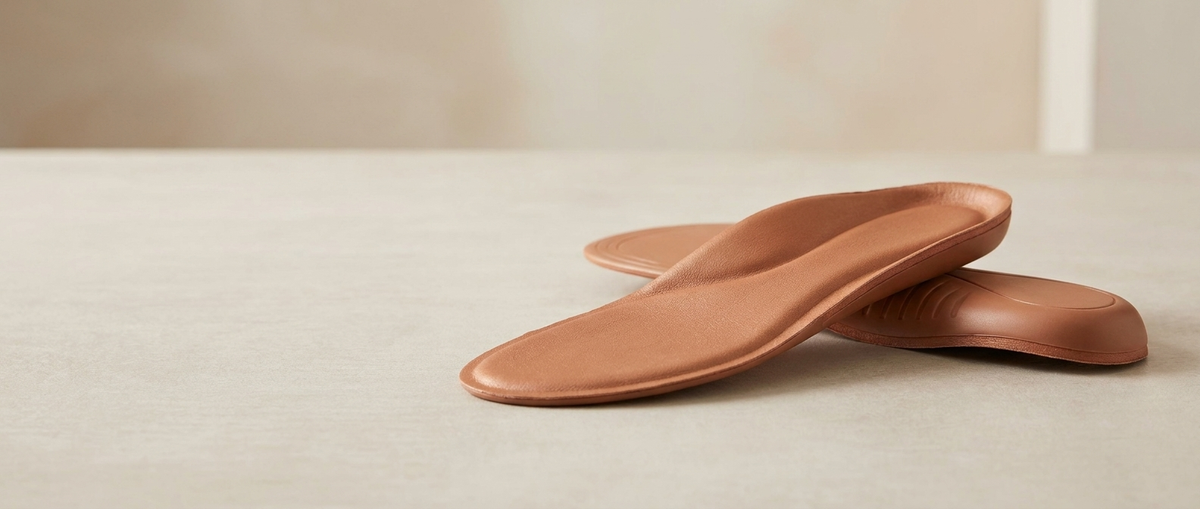
The Aetrex Premium Memory Foam Posted Orthotic ($79.95, women's here) is built around this: signature arch support plus a posted heel for the flat/low-arch pattern, and 43% more forefoot memory foam than other Aetrex orthotics for the pressure points high and neutral arches feel. It drops into shoes you already own.
If you'd rather the support be built into the shoe, the Chase Arch Support Sneaker (men's) and Erica Casual Sneaker (women's) carry the same Aetrex Orthotic System, with removable insoles if you want to add your own.
A foot scan is a fitting tool, not a medical evaluation. If you have persistent pain, a very rigid or rapidly changing arch, numbness, or diabetes, see a foot-health professional for a proper assessment rather than relying on a scan alone.
What's the most accurate way to find my arch type? A 3D foot scan. An Aetrex Albert 2 Pro scanner measures arch height, width, and pressure in a few minutes, and it's free at Aetrex retailers.
Do men's and women's feet need different arch support? The principles are the same; Aetrex offers its orthotics and arch-support shoes in men's and women's versions sized and shaped to fit each.
Does arch type change over time? It can — with age, weight change, or pregnancy. It's worth re-scanning if your feet start feeling different.
“Whenever your foot hits the ground, there’s an equal and opposite impact force that pushes back up through your body. To accommodate this force, your body is designed to absorb some of that shock. if it doesn’t absorb or distribute that force well, it can contribute to discomfort that may affect the foot or other joints. Depending on your alignment and footwear, this can contribute to pain and overuse injuries. One of the main reasons I encourage patients to use orthotics is because of how they can redistribute forces through the foot to support more optimal alignment. Over time, this may reduce stress on the joints and promote better body mechanics.”
— Dr. Brian Nicholls, DO (Emergency medicine)
Shop the full range at aetrex.com. This article is general information, not medical advice.
Share:
Supportive Shoes You Don't Have to Bend Down to Fasten
Which Shoe Insert for Which Foot Problem? A Simple Guide