

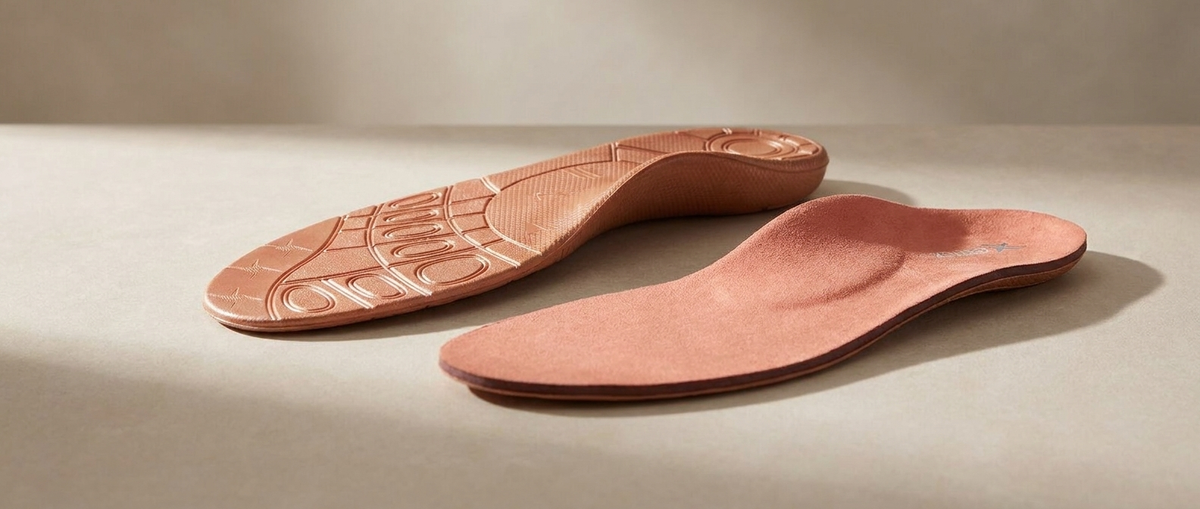
In Short: Most everyday foot pain traces back to how your foot is supported and cushioned. Rather than buying a different gadget for every ache, the smarter move is to match one well-designed orthotic to the problem you actually have — arch pain, heel pain, or ball-of-foot pressure. Here's how to pick. This is general information, not medical advice.
Insert shopping goes wrong when people buy by feel ("something soft") instead of by symptom. Cushioning alone masks pain; structured support changes the mechanics causing it. So start with the location:
Arch pain or a collapsing arch. You need structured arch support that holds the arch in position, plus a posted heel to control the inward roll that over-stretches the arch. Soft foam won't do this.
Heel pain, worst on the first steps. This is the plantar fasciitis pattern. The fix is the same arch support (to reduce fascia over-stretch) plus cushioning at the heel to absorb impact.
Ball-of-foot pain or burning. Pressure is concentrated too far forward. You want extra cushioning exactly under the forefoot, plus support that keeps your weight from loading the ball of the foot as heavily.
The Aetrex Premium Memory Foam Posted Orthotic ($79.95) is built to handle all three of the above, which is why it's a sensible default. It pairs signature arch support with a posted heel to control over-pronation — that addresses arch pain and the plantar-fasciitis heel pattern. And it carries 43% more memory foam in the forefoot than other Aetrex orthotics, placed right at the ball of the foot, for forefoot pressure. It drops into most everyday shoes once you remove the factory insole.
Shop Premium Memory Foam Orthotics
If you'd rather not manage a separate insert, Aetrex builds the same orthotic system into footwear. The Chase Arch Support Sneaker (men's, from $159.95) and the Erica Casual Sneaker (women's, $139.95) both have arch support and cushioning engineered in, with removable insoles if you ever want to swap in your own. Same support, no separate step.
Match the insert to the symptom, not the sensation: structured arch support and a posted heel for arch and heel pain, forefoot cushioning for ball-of-foot pressure — and a single well-built orthotic like the Aetrex Posted Orthotic covers all three.
How do I know which insole I need? Go by where it hurts. Arch and heel pain need structured arch support and a posted heel; ball-of-foot pain needs forefoot cushioning. The Aetrex Posted Orthotic combines both.
Do I need a different insert for each foot problem? Usually not. A well-designed orthotic addresses the common cases together rather than requiring a separate product for each.
Insert or a supportive shoe? Either works. An orthotic drops into shoes you own; a shoe like the Chase or Erica builds the support in so there's nothing to add.
“Your feet serve an important purpose in the kinetic chain, which makes up how the whole body is connected and works together. This chain is important to understand because it can influence how forces move through the ankles, knees, hips, and so on. To encourage better alignment starting at the foot, Aetrex has made their insoles with a special arch design that can assist with foot positioning. It gives me confidence to see research supporting the effectiveness of insoles like these. Clinical findings indicate that people who regularly wear insoles with good arch support can see changes in foot mechanics and alignment.”
— Dr. John Kasper, DO (Internal Medicine)
Shop the full range at aetrex.com. This article is general information, not medical advice.


Share:
How to Find Your Arch Type — and the Support It Needs
Supportive Shoes You Don't Have to Bend Down to Fasten